
The popular Goan Konkani hymnal, ‘Gaionancho Jhelo’ has been used by millions of Goan Catholics during liturgical and para-liturgical services and celebrations in Goa and across the world for nearly six decades.
---------------------------------------------
Did you know...
* There were no Goan Konkani carols before 1963
* The first Goan Konkani carol was written on the steps of a church
* A humiliating experience inspired a Jesuit priest to compose the lyrics of over 300 Konkani hymns
* An acclaimed Hindu poet has penned the lyrics of a popular hymn
* There is a mammoth 18-verse hymn on St Francis Xavier
* The popular Goan Konkani hymn book Gaionancho Jhelo is nearly 60 years old
* The Gaionancho Jhelo contains over 550 hymns, over 2,000 melodies
* The youngest composer of a liturgical melody has been a 12-year-old boy
---------------------------------------------
MELVYN MISQUITA pieces together for the first time a comprehensive and fascinating story of the popular Konkani hymn book, ‘Gaionancho Jhelo’, used by millions of Goan Catholics during liturgical and para-liturgical services and celebrations in Goa and across the world for nearly six decades.
The writer wishes to express his gratitude to the following persons for their valuable inputs to, and recollections of, the fascinating story behind the Gaionancho Jhelo:
* Late Fr Vasco do Rego (8 Jan 1925 - 17 Feb 2021)
* Fr Joaquim Loiola Pereira (Secretary to the Archbishop of Goa and Daman
* Fr Lino de Sa (Parish Priest at Our Lady of Candelaria Church, Camurlim-Salcete)
* Canon Saturnino Dias (Sarzora)
* Fr Bernardo Cota (Teaching Staff at the Seminary of Our Lady, Saligao-Pilerne)
* Fr Antonio Da Costa (USA)
* Fr Afonso Mendonca (Director of Diocesan Centre for Liturgy)
* Orlando Vaz (Saligao)
Melvyn Misquita
January 8, 2022
---------------------------------------------
ABBREVIATIONS:
DCL: Diocesan Centre for Liturgy
DCSM: Diocesan Commission for Sacred Music
DBG: Devacheam Bhurgeanchim Gitam
---------------------------------------------
THE BACKGROUND
Hymns are an integral part of the Catholic faith and millions of Goan Catholics have been singing numerous Konkani hymns during liturgical and para-liturgical services and celebrations in Goa and across the world.
But not many are aware of the dedication, passion and brilliance of one composer behind most of those Konkani hymns. The pioneering efforts of the Goan Jesuit, Fr Vasco do Rego (96), former Rector at the Bom Jesus Basilica in Old Goa (1979-95), and his collaborators, have led to his popular Konkani hymnal ‘Gaionancho Jhelo’ (Garland of Hymns), sung by Goan devotees across the world for nearly six decades.
What began as a 3 paise hymn booklet sometime in 1963 is today a full-fledged Konkani hymnal, described by Fr Joaquim Loiola Pereira as “not just a book of religious poems, but a veritable summula of Catholic theology and spirituality, perhaps one of the best exemplars of a Catholic Hymnal ever.”
Incidentally, the Gaionancho Jhelo might not have taken shape, had it not been for an embarrassing experience faced by Fr Rego, while a seminarian pursuing theology in Belgium (1952-56). That unpleasant incident eventually led Fr Rego to compose Goa’s first Konkani Carol and later, hundreds of original Konkani hymns, many of which are part of a classic Christian music heritage today.

Fr Vasco do Rego sings his composition of Goa’s first Konkani Carol ‘Visvasacho Dis’ from the Goan Konkani hymnal, ‘Gaionancho Jhelo’ on December 5, 2014.
Photo: Melvyn Misquita
“We were among the students of Theology from 17 countries in that French-speaking Belgian Theologate. Two of us hailed from Goa. During our first Christmas there in 1952, all were asked to sing carols in their native language, group by group. When it was our turn, we felt deeply ashamed as we did not have in Goa a single Konkani carol in 1952,” recalled Fr Rego, during an interview with this writer in December 2014.
“What humiliated me most was that the Congolese companions of ours, these second generation Catholics, sang carols in their own language, and we Goans couldn’t do so, even though the Christian faith in Goa had been ours for over 400 years.”
“At that moment, an indescribable inner communication made me understand that I myself would, someday, rectify this embarrassment and see that we have carols and other hymns of our own,” Fr Rego added.
THE PRECURSOR
While the Gaionancho Jhelo is the best known and most recognised Goan Konkani hymn book for nearly six decades, it is not the first Konkani hymn book published in Goa. For, that honour goes to a little known hymn book published in 1960.
According to Fr Lino de Sá, the foresight of Fr João Baptista Viegas, then professor of music in Saligao Seminary, had led to the birth of the Konkani Hymn booklet ‘Povitr Misachi Bhett Gaianamnim’ (The Holy Sacrifice of the Mass in hymns).
“Before the appearance of Gaionancho Jhelo in 1963, an initiative of Fr Rego, there was a pioneering effort of Fr João Baptista Viegas, then professor of music in Saligao Seminary, to help towards active participation of the faithful in the Holy Mass, by publishing a booklet ‘Povitr Misachi Bhett Gaianamnim’ on February 5, 1960,” recalled Fr de Sá.
“This booklet contained nine hymns with lyrics by Belarmino Lobo from Colvale and music by Fr Viegas, besides a commentary on the respective parts of the Mass. It was printed with musical notations at Tipografia Rangel, Bastora-Goa. Fr Viegas also recorded the same hymns on a 73 rpm gramophone disc.”
“What a far-sighted vision this priest had to interpret in anticipation the mind of the Church, which was manifested two years later through the Second Vatican Council, with regard to the active participation of the people in the Mass!” Fr de Sá added.
Fr Vasco do Rego recalled his association with Fr Viegas and his contribution to Konkani hymns.
“Returning from Belgium in 1957, I met the zealous and dedicated Fr João Baptista Viegas, four years my senior, my friend since my days as a seminarian in Rachol. Already known for his musical talents, he too had come back from Spain after some 4-5 years in Europe. He received there some extra training in music and liturgy,” says Fr Rego.
“When we were in Europe, the atmosphere, particularly in theology and liturgy, was bubbling with new ideas and movements. France, Belgium, Germany and Spain were moving towards, and preparing the ground for, Vatican II.”
“On his return, Fr Viegas was re-appointed to the Saligão Seminary as professor of music, liturgy etc. Flanked by a couple of us -- all friends -- he persuaded good old Belarmino Lobo, also a friend of mine, who used to write lyrics of his own, to compose, under his guidance, appropriate lyrics for hymns to be sung at different stages of the Mass. Belarmino obliged with his real devotion to God. That is how a booklet was published in 1960, entitled ‘Povitr Misachi Bhett Gaianamnim’.”
“This was prior to the Post-Vatican II reformed Missal. I was happy to include in the Gaionancho Jhelo six of those nine lyrics from the booklet Povitr Misachi Bhett Gaianamnim, the other three being “out-of-tune” with the new Missal. The unassuming Fr Viegas composed excellent and appropriate melodies for the same,” Fr Rego added.
THE BIRTH
Fr Vasco do Rego returned to India in 1957 and, after about five years of other ministries in Pune, was appointed Spiritual Director at the Patriarchal Seminary of Rachol in June 1963. Since he had received training in Europe, he was asked, that same year, to direct a special ‘Liturgical Retreat’ for priests.
“In those days, our hymns were mostly translated from Portuguese or English. For the purpose of that ‘Liturgical Retreat’, I was drawn to compose (lyrics and music) about a dozen original Konkani hymns that would be necessary for the various steps of the retreat. Those hymns were then officially approved by Fr Camilo Xavier of Margão, then president of the Diocesan Commission for Sacred Music,” says Fr Rego.
Thrilled to hear these new Konkani hymns, fellow priests quickly learnt them from cyclostyled sheets, which Fr Rego had painstakingly prepared with the help of some enthusiastic seminarians, during the retreat.
“The participants even had a “practice session” of the hymns during intervals between Meditations, etc.,” recalled Fr Rego.
Then came an unusual offer from his friend, Fr Xavier, giving him the opportunity to shake himself free from his humiliating experience in Belgium.
“One day, Fr Xavier, my good and personal friend, asked me to translate an Italian carol into Konkani, as he wanted to have it sung over All India Radio, Panjim, by a choir he directed in Margão. I bluntly rejected the offer, as I refused to be a slave to another foreign language (after Portuguese). Fr Xavier understood my refusal,” said Fr Rego.
“After this incident, I sat on the side-steps of the Rachol Seminary church with my pen and paper one day in October 1963 and composed Goa’s first Konkani carol, ‘Visvasacho Dis’. The hymn was quickly approved by Fr Xavier,” he added.

“Had the hour arrived for the realization of that inner communication experienced in Belgium in 1952?” wondered Fr Rego.
After that hymn, Fr Rego went on to compose several other lyrics and melodies for Konkani hymns, which were also approved for liturgical use.
Fr Rego took pains to clarify that his musical contributions were never aimed at personal glory.
“The composition of hymns was never, truly never, for personal interest or advantage, name or fame. It was not even for the development of Konkani or to contribute to Konkani literature. That is why I had never appended my name to each composition when it was published,” explains Fr Rego.
“I just wanted to do the service that Jesus was leading me to do in our concrete circumstances: I wanted to “feed” my people, not just with any kind of hymns, but with music deeply rooted in the gospel and in our Christian faith.”
“Hence, without any boasting or pride, I must acknowledge with heartfelt thanksgiving that all my lyrics are, as competent persons have observed, “deeply meaningful, solidly doctrinal, aptly catechetical and liturgically suited to our liturgy”, for various occasions. And the melodies which I myself composed are simple for singing, as witnessed in our churches and chapels etc.,” said Fr Rego.
THE PRINT
Keen to make these hymns readily available, Fr Vasco do Rego then bound his cyclostyled hymns into a booklet sometime in 1963.
Incidentally, the title ‘Gaionancho Jhelo’ was coined by Canon Saturnino Dias, who was a seminarian under Fr Rego.
“While these hymns were being composed and they were being practised and sung in the Rachol Seminary, the need was felt to compile them. I was the lucky person to do the job because in those days, much of the typing and cyclostyling in the Seminary was done by me,” recalls Fr Dias.
“I discussed with my colleagues about the name for the compilation and, while some suggested Gitancho/Songitancho Mollo/Jhelo, I thought of Gaionancho Jhelo and I proposed it to Fr Rego. He too accepted the name.”
“I then cyclostyled it in such a way that we could fold the A4-sized papers so as to form a small booklet. My seminary companions, such as Manuel Lobo, Avinash Rebelo, Jose Roque Gonsalves, Camilo Godinho, Denzil Dias and Ivor Rodrigues, helped me fold and present them in small booklets. We worked at night, in fact, at a time when we were supposed to maintain rigorous silence, after 10 pm.”
“One night, the Rector, Msgr. Carmo da Silva, happened to pass by and on hearing the sound of our talk and giggles, he came to check what we were doing. Naturally, he did not like the noise and reprimanded us. But he condoned our behaviour when we told him that we were preparing a booklet of new Konkani hymns and could not do it during the day, as each of us was busy with other things.”

Gaionancho Jhelo remained in cyclostyled form for some time and when the Diocesan Centre for Liturgy (then known as the Diocesan Liturgical Commission) decided to print it, I was already in Rome. I may still have a cyclostyled copy of it somewhere in my bookshelves,” added Fr Dias.
Incidentally, Orlando Vaz of Saligao has preserved two pages from these original cyclostyled sheets of the Gaionancho Jhelo, which were in circulation sometime around October 1963 till about 1965, before books of the Gaionancho Jhelo were subsequently published and printed.
Narrating the story behind the two pages from these original cyclostyled sheets of the Gaionancho Jhelo, which he preserved for decades, Vaz said: “When I was studying at Rachol Seminary from 1975 to 1982, Fr Camilo Xavier put me in charge of music from 1980 to 1982.”
“It was then while going through the various books of Church or liturgical music that these two priceless cyclostyled hymn sheets caught my eye and I decided then and there to preserve them for posterity.”
“I tried my best to find more of such priceless papers but to no avail. I regret the loss of all those sheets more because it is a loss of historical importance,” said Vaz, who went on to teach solfeggio at Kala Academy from 1985 to 2017 and was also involved in composing music to a few melodies for liturgical use.
In fact, Vaz has also preserved the first few score sheets of the Devacheam Bhurgeanchim Gitam, which were printed after the cyclostyled copies of the Gaionancho Jhelo. These score sheets were later published as Volume 1.
THE SPREAD
Fr Vasco do Rego was quick to admit his “poor business skills” in marketing his Gaionancho Jhelo.
“I was a terrible businessman. I would spend 2.5 paise from my own personal funds to prepare these Gaionancho Jhelo booklets. They were then sold at 3 paise in B X Furtado (Margao), a meagre profit of 0.5 paise,” laughs Fr Rego.
“Gaionancho Jhelo soon became a popular Konkani hymn booklet among priests and people alike, in different parts of Goa.”
“My cyclostyled booklets must have continued until 1965. In 1966, I approached the Tipografia Boa Imprensa (Margao) to print the booklet. All details were worked out by me, and I bore all the expenses.”
“However in 1967, I was unable to continue personal funding of the Gaionancho Jhelo and hence, I donated the collection to the Diocesan Centre for Liturgy (DCL). They were only too happy to accept these ready-made hymn books. It was agreed between us that I would continue as editor and do all the services I was rendering: composing new hymns, getting others too to compose, selecting and editing the same, etc. Everything was done in complete understanding and collaboration.”
“The 1967 Edition was printed in the Tipografia Boa Imprensa by the DCL, with an Imprimatur dated December 14, 1967 by Bishop Francisco Rebello, who was then the Apostolic Administrator of Goa Archdiocese. Incidentally, I left Rachol in May 1967,” said Fr Rego.
Fr Rego continued to compose hymns for the Gaionancho Jhelo for several years. Among his numerous contributions, Fr Rego also composed a lengthy 18-verse hymn Sonvsarak Jezu Diat, one of the longest hymns in Gaionancho Jhelo, in honour of St Francis Xavier.
“This lengthy 18-verse hymn on St Francis Xavier was composed on the occasion of the 14th Solemn Exposition of the Relics of St Francis Xavier (1984-85).
Incidentally, the theme of the Exposition was ‘Sonvsarak Jezu Diat’ (Give the world Jesus) and hence, my hymn,” said Fr Rego.
“Composing this long hymn was not a joke. I wanted each stanza to express ways and occasions of “giving the world Jesus”. The Maestro Fr Lourdino Barreto did a wonderful orchestration of my music and thus heightened my own composition,” acknowledges Fr Rego.
Ten years later, the entire year 1994 was devoted to the ‘Family’ in the whole world. So, on the occasion of the 15th Solemn Exposition (1994-95), the theme chosen by the Archdiocese of Goa and Daman was ‘Kuttumbant môg, jivit, kallji; somazant nit, bhavponn, xanti: Devachi hich khori bhokti.’ (In the Family: love, life and care; in society: justice, sisterly-brotherly relationships, and peace: This is true worship of God.)
“It was an occasion for me to compose special lyrics on this theme as well as to set them to music. However, this hymn does not appear in the Gaionancho Jhelo,” said Fr Rego.
Fr Rego estimates to have composed lyrics to over 300 hymns, besides composing music to over 50 hymns.
“I have composed several more hymns, but they have not been included in the last edition of Gaionancho Jhelo which was published around 1995, the same year I ended my 16-year tenure as Rector of Bom Jesus Basilica,” he added.
THE RECOGNITION
Acclaimed Goan Konkani Gospel musicians and former seminarians of Fr Vasco do Rego have praised his contributions and have acknowledged his efforts in the Gaionancho Jhelo.
Fr Bernardo Cota has described Fr Vasco’s compositions as “gems of liturgical songs.”
“I was a seminarian in Rachol when the Vatican Council determined that the faithful should participate actively in the Holy Eucharist, in their respective local languages. And that they should sing as a congregation. This was in 1963. Prior to this, people would go to “hear” Mass and they would listen to the choir or the Mestri singing in Latin,” recalls Fr Cota.
“Fr Rego, our Spiritual Director, headed the great movement of creating new hymns in Konkani (lyrics and music) for congregational singing. He began by composing beautiful Christmas Carols, which are still being sung throughout Goa. ‘Visvasacho Dis’, ‘Sang Kiteak Ailai Balla’ and ‘Mariechea Khandar Nidla’ are some of that first batch of compositions.”
“Then came the Lenten and the Easter season and he came up with unforgettable hymns like ‘Tuji Povitrtai’, ‘Tum Mog Moguch Deva’, ‘Patok Mhojem Kedem’, ‘Mornnantlo Jivo Zalo’, ‘Nirbhagi Amchim Kallzam’, etc.”
Fr Cota said these hymns “were all cyclostyled by the seminarians and spread as far as they could go, after obtaining due permission from the diocesan authority.”
“Very soon, there was a need to create vernacular hymns to be sung during liturgy, like Entrance, Offertory, Communion and Recessional hymns. Again, Fr Vasco came up with gems of liturgical songs, based on the Scripture and in conformity with the new spirit of the Liturgy, promoted by Vatican II. This was the time when they were all published in a book form, under the same name of Gaionancho Jhelo.”
“Today, Gaionancho Jhelo has more than 500 hymns, more than 2,000 melodies published by the Diocesan Commission for Sacred Music and more than a hundred lyricists and music composers, among whom I have contributed with about 200 melodies,” informed Fr Cota.
Fr Cota said it was heartening to see that each Church and Chapel in Goa has its own choir, which renders free service to the Lord, who gifted them with their musical talent of singing and playing.
“Most of them sing in voices, at the very least, in two voices. Many choral groups or individuals have recorded their singing in well produced and widely marketed audio discs. May liturgical musical creations grow and help our congregations to participate ever more actively and joyfully in the liturgy,” says Fr Cota.
Fr Antonio Da Costa, hailing from Curtorim and now based in the USA, remembered his early association with the Gaionancho Jhelo.
“Fr Vasco do Rego was my Spiritual Director at the Rachol Seminary and the short time I spent under him before my transfer to the Papal Seminary in Poona, was very exciting.”
“The Vatican II Ecumenical Council began in 1962 and by 1964, the Council Fathers came out with the recommendation to use vernacular language in our Church Liturgy, instead of Latin.”
“Prior to the Vatican II, we had lots of hymns in Konkani in honour of Mother Mary and other saints, which we used for the famous litanies in our homes and the wayside chapels etc. However, we hardly had any hymns suitable for Mass since the liturgical music was in Latin.”
“Personally, I was very happy that the Church finally allowed to have liturgical services in the language people spoke and understood. All of us were overjoyed and Fr Vasco, being a great enthusiast of Konkani language, didn’t waste time to start his pioneer work to fill in the need for hymns in Konkani suitable for various parts of Mass and other liturgical services.”
“So, having the liturgy in vernacular was a big victory for God's people everywhere. My experience was that of elation and satisfaction on having the opportunity to be part of this monumental work of creating a hymnal in our own language, to help our people to praise Lord in the language they spoke and understood.”
“Knowing that we were creating or assisting to create hymns for the posterity, was a wonderful and rewarding experience. Too bad, I had to leave the Rachol Seminary and move to Papal Seminary, when this important work was just in its inception.”
“The first pioneer to have theologically sound hymns for various parts of the Mass was started by Fr João Batista Viegas, my professor of music at the Saligão Seminary around 1960.”
“This work filled the gap until Fr Vasco came up with loads of new hymns appropriate for Mass like the entrance hymn, offertory hymns, communion hymns, meditation hymn after the communion and recessional hymn, but also hymns for every service in the Church,” said Fr da Costa.
Praising Fr Rego’s “great efforts to make the Word of God known in Konkani,” Fr Saturnino Dias said Fr Rego deserved all the credit.
“There is no denying that Fr Rego made great efforts to make the Word of God available in Konkani and composed a great number of Konkani hymns and also encouraged others to compose hymns in Konkani. He deserves full credit in this,” admits Fr Dias.
“In fact, many of us felt that he was overzealous to present it in “pure” Konkani by purging all Portuguese influence, including words that had already become part of the Konkani vocabulary like “padri” and “altar”, substituting them by "iadnik” and “vedi” respectively. This made it difficult for people to understand and led many to prefer English to Konkani, stating “tumchi Konknni amkam somzonk iena. (We don’t understand your Konkani)”
“Though much effort was made to explain that the new words were taken mostly from Sanskrit and Hindi, you will find people till today who prefer English to Konkani because of this. In any case, he got full cooperation from the Seminarians of Rachol and in a particular way, from our batch,” said Fr Dias.
THE EDITIONS
From a simple cyclostyled hymn booklet which was printed sometime in 1963, the Gaionancho Jhelo has undergone several transformations in shape, size, design and content.
The Gaionancho Jhelo had been in a cyclostyled format for some time till Fr Vasco Rego officially handed over the publication to the Diocesan Centre for Liturgy (then known as the Diocesan Liturgical Commission).
The Diocesan Centre for Liturgy (DCL) and the Diocesan Commission for Sacred Music (DCSM) are both involved in the Gaionancho Jhelo.
“While the lyrics fall within the domain of the DCL, the music for the lyrics is the responsibility of the DCSM. As a hymn book, the Gaionancho Jhelo is owned, managed and published by the DCL,” explained Fr Afonso Mendonca.
Under the DCL, the Gaionancho Jhelo has, so far, gone through eight editions in 1967, 1971, 1974, 1976, 1979, 1984, 1988 and 1993.

The first edition of Gaionancho Jhelo was printed at Boa Imprensa, Margao, on December 14, 1967. This is the smallest book in size. The second edition of Gaionancho Jhelo was also printed at Boa Imprensa, Margao on May, 29, 1971.
The third edition of Gaionancho Jhelo was printed at Casa J D Fernandes, Panjim in February 1974. The fourth edition of Gaionancho Jhelo was printed at Jokap Printers, Belgaum on April 4, 1976 and priced at Rs 2.50.
The fifth edition of Gaionancho Jhelo was printed at Bandekar Printers, Curchorem, on February 16, 1979 and priced at Rs 3. The sixth edition of Gaionancho Jhelo was printed at Borkar Xhapkhanno, Margao on May 29, 1984.
While a copy of the seventh edition of Gaionancho Jhelo was not available with the DCL, the Eighth edition of Gaionancho Jhelo was printed at New Age Printers, Panjim on April 14, 1993.
THE COLLABORATION
What makes the Gaionancho Jhelo a special collaborative effort is that it is truly a “Jhelo” (garland) of composers of both lyrics and melodies, who hail from all walks of life and across different ages.
Fr Vasco do Rego had encouraged his seminarians to compose lyrics and music for hymns as well and he acknowledged the efforts of his students in Gaionancho Jhelo.
“Some of my students, like Fr Bernardo Cota, became acclaimed musicians in their own right. I’m truly happy and proud that they rose to heights far above myself,” admits Fr Rego.
Fr Antonio Da Costa admitted that Fr Vasco also encouraged seminarians under him to compose new melodies as well as to write music for hymns and other liturgical music.
“Fr Vasco began to compose lyrics and music to these new hymns and encouraged us, seminarians, who were proficient in reading and writing of music, to compose new melodies as well as to write music on stencils, which were used to make copies on the cyclostyle machine and distribute to all the churches of our Archdiocese.”
“I composed a few melodies and wrote music on the carbon copy type stencils that were used on the mimeograph machine to print copies.”
“It was amazing to witness the flourishing of this movement, discovering so many composers within ourselves in the seminary and outside the seminary,” said Fr Da Costa.
Stating that Fr Rego’s hymns are “very rich in theology”, Fr Lino de Sá mentioned that his contribution came in response to the Vatican II Document on Sacred Liturgy (1963).
“Fr Rego, at the time Spiritual Director in the Patriarchal Seminary of Rachol, came up with the first compositions (lyrics as well as music) for Konkani liturgical hymns, according to the spirit of the Council, in order to facilitate the active participation of the people in the Mass, celebrated now in the vernacular language,” said Fr de Sá.
“He also encouraged seminarians and other talented priests to compose hymns.”
“In due time, the Diocesan Commission for Sacred Music (DCSM) was assigned the task to set music to the hymns from this book or examine new musical compositions for the same, before submitting them to the approval of the ecclesiastical authority.”
“The DCSM has been at this task till date and it keeps publishing such compositions (with musical notations) periodically under the name of Devacheam Bhurgeanchim Gitam (DBG). So far, the DCSM has brought out 28 issues of DBG,” said Fr de Sá.
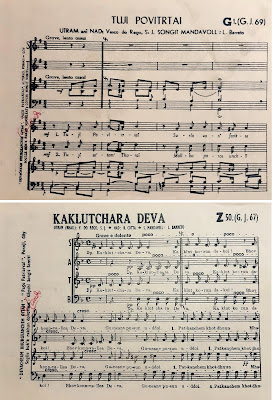
The first score sheets of the Devacheam Bhurgeanchim Gitam, which were printed after the cyclostyled copies of the Gaionancho Jhelo. These score sheets were later published as Volume 1.
Photo courtesy: Orlando Vaz
“In its present format, the Gaionancho Jhelo has gone through eight editions so far. Most of the hymns are composed by Fr Rego. The lyrics of his hymns are very rich in theology and are strictly metered and rhymed. This book now contains a total of 555 hymns, including some traditional ones. Fr Rego has 239 original lyrics and 66 translated from the original in Latin in this book. Many of these have also melodies composed by him.”
“When I was studying Philosophy in Rachol Seminary, the Gaionancho Jhelo inspired me to compose some new lyrics, which were included in the 1976 edition, after due approval of ecclesiastical authorities. Later, some new compositions of mine were added in the 1988 edition. In all, 58 hymns in Gaionancho Jhelo have my lyrics, while 53 have been melodies composed by me,” Fr de Sá added.
Fr de Sá said lyrics in the Gaionancho Jhelo have also been composed by Fr Moreno de Souza SJ (22), Fr Aloisio da Cruz SJ (8) and Fr Ubaldo Fernandes SFX (4). Besides, six lyrics by Belarmino Lobo from the booklet Povitr Misachi Bhett Gaianamnim have also been included in the Gaionancho Jhelo.
“Others who have also composed lyrics for one or two hymns in the Gaionancho Jhelo include the priests, Fr Alfred Vas, Fr Anand Aguiar, Fr Anthony Rodrigues, Fr Bernardo Cota, Fr Francisco Miranda, Fr Joaquim Loiola Pereira, Fr Socorro Dias do Rosario and Fr Tomas D’Aquino Sequeira, as well as the lay persons, Alcantara Barros, Anthony D’Souza, Joaquim Rodrigues, Jose Santana Cota, Pedro Salvador Carneiro and Raimundo Barreto.”
“Besides, the Gaionancho Jhelo also includes lyrics of traditional hymns (42), lyrics by anonymous authors (35) and lyrics by those from Mangalore (5).”
“I have 24 more hymns (lyrics) for special occasions which have the Nihil Obstat from the Diocesan Centre for Liturgy and approval of the Diocesan Authority. I do hope they will be incorporated in future editions of Gaionancho Jhelo,” said Fr de Sá.
Fr Antonio Da Costa recalled that during the 1960’s, he had composed melodies for at least three hymns, the lyrics of which were composed by Fr Vasco.
"I can remember only one "Horeb Porvotar Ami”. Now, I don't even remember the names of others,” said Fr da Costa.
“I have now composed five new melodies set to the lyrics by Fr Vasco, but they would need approval of the Diocesan Commission for Sacred Music (DCSM).”
As on 2021, as many as 119 people have been credited as composers of melodies for the various hymns in the Gaionancho Jhelo.
The 49 priests (in alphabetical order) who have composed melodies for the various hymns in the Gaionancho Jhelo are Fr Agnelo D'Souza SFX (Pilar), Fr Agnelo Mendes (Moira), Fr Aleixo Menezes (Curtorim), Fr Alexandre Pereira (Betalbatim), Fr Aloisio da Cruz SJ (Aldona), Fr Anthony Rodrigues (Canacona), Fr Antonio Cotta (Margao), Fr Antonio da Costa (Curtorim), Fr Bernardo Cota (Santa Cruz), Fr Dennis Fernandes (Parra), Fr Eufemiano Miranda (Cortalim), Fr Felix Lobo (Chinchinim), Fr Francisco Miranda (Cortalim), Fr Freddy Rodrigues SFX (Pilar), Fr George Aguiar (Colva), Fr Glen D'Silva SFX (Pilar), Fr Henrique Medeira (Loutolim), Fr Ivo da Conceicao Souza (Calangute), Fr Jean da Cruz Fernandes (Benaulim), Fr Joao Baptista Viegas (Pilerne), Fr Joaquim Loiola Pereira (Benaulim), Fr Jose (Joe) A Rodrigues (Merces), Fr Lino de Sá (Betalbatim), Fr Lourdino Barreto (Galgibaga), Fr Lyndon Rodrigues SFX (Pilar), Fr Mansueto Fernandes (Paroda), Fr Mariano Silveira (Marcela), Fr Mario Baretto (Verna), Fr Mario Vaz (Loutolim), Fr Martinho Fernandes (Neura), Fr Mathew Rodrigues (Usgao), Fr Max Gonsalves SFX (Pilar), Fr Nascimento Mascarenhas (Saligao), Fr Nery Mendes SFX (Pilar), Fr Olavo Caiado (Carambolim), Fr Olavo Velho Pereira (Benaulim), Fr Peter Cardozo SFX. (Pilar), Fr Roland Carvalho (Benaulim), Fr Santana Carvalho (Aldona), Fr Santana Faleiro (Raia), Fr Saturnino Mascarenhas SFX (Pilar), Fr Sertorio Rodrigues (Raia), Fr Simon D’Cunha (Azossim), Fr Socorro Dias do Rosario (Agassaim), Fr Tomas D'Aquino Sequeira (Corlim das Ilhas), Fr Tony D’Souza (Assagao/Mumbai), Fr Valmiki Dias (Arossim-Cansaulim), Fr Vasco do Rego SJ (Panjim) and Fr Vijay Anand (Aldona).
Incidentally, Fr Bernardo Cota has been one of the prolific composers, having contributed about 200 melodies for the various hymns in the Gaionancho Jhelo.
The 70 lay people (in alphabetical order) who have composed melodies for the various hymns in the Gaionancho Jhelo are Abrao D'Souza (Siolim), Agostinho da Fonseca (Calangute), Alcantara Barros (Velim), Alberto Baretto (Santa Cruz), Albino Fernandes (Consua-Verna), Alex Rodrigues (Malad-Mumbai), Armstrong Monteiro (Loutulim), Anthony D'Souza (Siolim/Mumbai), Anthony Calisto Vaz (Piedade), Aquino Almeida (Velim), Augusto Costa (Panchwaddi), Benny Fred Fernandes (Benaulim), D X Tavares (Aldona), Domnic C D'Souza (Cansa-Tivim), Dominic Peixoto (place unknown), Esmera Remedios (place unknown), Eustaquio Souza (Saligao), Fabiola Lopes (Old Goa), Fernando Afonso (Taleigao), Fexson John Colaco (Velim), Francis Anthony Fernandes (Saligao), Francis Rodrigues (Corlim das Ilhas), Francisco Quadros (Bastora), George D'Gama (Saligao), Irineu D'Souza (Vasco), James Colaco (place unknown), Jerome Rodrigues (Paroda/Mumbai), Jerry Cardozo (Loutulim), Joao Francisco Goes (Chinchinim), Joaquim (Jack) Rodrigues (Anjuna), Joaozinho (Johnson) Carvalho (Siolim), Joel Fernandes (Curtorim), John Amiano D'Souza (Salvador do Mundo), Johnny D'Cruz (Moira), Jose Antonio Dias Mendes (Chinchinim), Jose Santana Cota (Santa Cruz), Josefato Vales (Seraulim), Joseph Noronha (place unknown), Ligorio Fernandes (Benaulim), Lourenco Coutinho (Telaulim-Navelim), Luis Cota (Santa Cruz), Luis Coutinho (Orlim), Manuel Alphonso (Seraulim/Mumbai), Manuel Fernandes (place unknown), Maurelio A Cotta (Margao), Melcon Teixeira (Cortalim), Merwin Mascarenhas (Duler-Mapusa), Micael Martins (Orlim/Mumbai), Nelson D'Silva (Velsao), Noel Fernandes (Saligao), Orlando B Vaz (Saligao), P A Mascarenhas (Santa Cruz-Mumbai), Pascoal Lopes (Calangute), Pedro Antonio D'Costa (Aldona), Pedro Salvador Carneiro (Ucassaim), Raimundo Barreto (Loutulim), Reagan Fernandes (Loutulim), Ronny Fernandes (Loutulim), Rosario Fernandes (Candolim), Santana D'Souza (Candolim), Sebastian de Souza (place unknown), Sebastiao (Seby) Fernandes (Loutulim), Soter D'Souza (Porvorim), V J Fernandes (place unknown), Valentine D'Souza (place unknown), Valentino Mendes (Ucassaim), Vanessa Dias (Ambora-Camurlim), Varela Caiado (Merces), Victor da Costa (Curtorim) and Zindo Colaco (Baina-Vasco).

Fr de Sá said the cover of the present (eighth) edition of the Gaionancho Jhelo has been designed by Fr Olavo Velho Pereira of Benaulim.
Incidentally, the Gaionancho Jhelo is not just a collection of hymns, but it also includes the Order of the Mass in the first section of the hymnal, making it a perfect companion for Catholics participating in Masses celebrated in Konkani.
Besides the several composers of melodies for the hymns in the Gaionancho Jhelo, a number of priests and lay people have also composed melodies for the various sung parts of the Mass and even for responsorial psalms.
“These compositions are not included in the Gaionancho Jhelo, but are published in the periodical of the Diocesan Commission for Sacred Music, Devacheam Bhurgeanchim Gitam, with musical notations,” says Fr Loiola Pereira.
According to Fr de Sá, as many as 21 priests and 20 lay people have composed melodies for the various sung parts of the Mass -- which are featured in the first section of the Gaionancho Jhelo -- and for the responsorial psalms.
The 21 priests (in alphabetical order) are Fr Agnelo D’Souza SFX (Pilar), Fr Agnelo Mendes (Moira), Fr Antonio Cotta (Margao), Fr Bernardo Cota (Santa Cruz), Fr Felix Lobo (Chinchinim), Fr Francisco Miranda (Cortalim), Fr Henrique Medeira (Loutulim), Fr Jean da Cruz Fernandes (Benaulim), Fr Joao Baptista Viegas (Pilerne), Fr Joaquim Loiola Pereira (Benaulim), Fr Jose (Joe) A Rodrigues (Merces), Fr Lino de Sá (Betalbatim), Fr Lourdino Barreto (Galgibaga), Fr Marian Dias, SFX (Pilar), Fr Martinho Fernandes (Neura), Fr Max Gonsalves, SFX (Pilar), Fr Peter Cardoso, SFX (Pilar), Fr Reagan Fernandes, SFX (Pilar), Fr Tomas D’Aquino Sequeira (Corlim das Ilhas), Fr Tony D’Souza (Assagao/Mumbai) and Fr Vasco do Rego, SJ (Panjim).
The 20 lay people (in alphabetical order) are Abrao D’Souza (Siolim), Agostinho da Cruz (Curtorim), Alcantara Barros (Velim), Conchita Ribeiro (Saligao), Eustaquio Souza (Saligao), Francis Anthony Fernandes (Saligao), Irineu D’Souza (Vasco), Jerome Rodrigues (Paroda/Mumbai), Joaquim (Jack) Rodrigues (Anjuna), Jocelyn Dias (Chinchinim), Jose Santana Cota (Santa Cruz), Joseph Noronha (place unknown), Manuel Alphonso (Seraulim/Mumbai), Maurelio A Cotta (Margao), Micael Martins (Orlim), Pascoal Lopes (Calangute), Sebastiao (Seby) Fernandes (Loutulim), Terezinha da Costa (place unknown), Vanessa Dias (Ambora-Camorlim) and Varela Caiado (Merces).
According to Fr Lino de Sá, authenticating the composers of some melodies or lyrics has not been an easy exercise.
“Sometimes, the composers merely submitted their original melodies or lyrics, sometimes by hand, to the Diocesan Commission for Sacred Music or Diocesan Centre for Liturgy, without any covering letter along with composition. So, we could never ascertain their correct names or their places.”
“Besides in the composition published on DBG, we write only name of the composer without the place, making it difficult to know the place of the composer,” said Fr de Sa.
The youngest composer of an approved liturgical melody has been a 12-year-old boy and at least 11 others have also composed melodies for hymns while they were in their teens.
The credit for identifying these talented boys, mentoring them and honing their musical skills goes to Fr Loiola Pereira.
“When I used to teach in the Saligao Seminary (1980-87), I would encourage musically gifted students to compose tunes for the hymns in the Gaionancho Jhelo. I would listen to them, write the tunes down and send them for the approval of the Diocesan Commission for Sacred Music. I am happy that at least 12 of these young lads, who would have been between 12 and 19 years, feature in the list of those whose musical compositions are sung today in our churches,” said Fr Pereira.
“I must specially mention Francis Anthony Fernandes, Johnny D'Cruz and Merwin Mascarenhas: they must have been in Std 8 or Std 9 when their melodies were approved. Francis Anthony Fernandes must have been just 12 years old; his very short and lilting melody, "Jezuchea nanvan, Bapa" -- a response at the Prayer of the Faithful -- is sung full-throatedly, even today, in every church and chapel of Goa,” he added.
THE CONFLUENCE
A lesser known fact is that the hymn ‘Jezu Bhaxen’ in Gaionancho Jhelo has been written by the acclaimed Hindu Konkani writer-poet Manoharrai Sardessai. Fr Loiola Pereira has been credited for the inclusion of Sardessai’s lyrics in Gaionancho Jhelo.
Narrating the story behind the hymn, Fr Pereira said: “I had fallen in love with Sardessai's poem ‘Jezu Bhaxen’ from the time it was first published in 1966. I preserved with me a handwritten copy I had made of it.”
“Fifteen years later, when I was the music teacher and Choir Director at Saligao Seminary, I set a tune to that poem and taught our Seminary Choir, to be sung on the stage. I had clearly told my students: “this is not an approved hymn, it cannot be sung in church. Besides, this tune is for the stage, not for the church. So, it has to remain inside these walls”,” said Fr Pereira.

The popular choir 'Aradhon' has regularly performed Konkani hymns from the ‘Gaionancho Jhelo’.
Photo courtesy: Omar de Loiola Pereira
“I had created both the voice and the instrumental arrangement with a Latin American flavour. The boys loved it and some of them “ate the forbidden fruit!” During holidays, they taught the song in their parishes; it was soon being sung all over Goa.”
“Then came the embarrassment. In view of the rampant use of a non-approved hymn in our churches, the Diocesan Commission for Sacred Music asked me to submit my composition for due approval and so legitimise it. This was somewhere in 1993. It was only then that the Diocesan Centre for Liturgy included the lyrics of the song in the Gaionancho Jhelo and thus finalised the 'legalisation',” said Fr Pereira.
THE TRIBUTE
In his research paper presented at a seminar on ‘Prosody in Konkani Religious Literature’ at Kala Academy, Panjim, on October 29, 2011, Fr Lino de Sá said the lyrics of Fr Vasco do Rego “are based on Christian teachings and on the Bible, full of theology and inspiration for the daily living of a Christian who tries to live by his faith and morals. His language is of high standard, yet simple.”
Fr Antonio Da Costa said by the time he finished his theological studies in Poona in 1969 and returned to Goa as ordained priest, the Gaionancho Jhelo had grown into "a thick hymnal of cyclostyled sheet music in Konkani with multiple hymns for mass and every liturgical service.”
“The tiny seed planted by Fr Vasco do Rego in Rachol Seminary blossomed into the most comprehensive and the best companion to the Liturgy in vernacular in whole India. The Archdiocese of Goa and the Konkani Catholic faithful throughout India will be forever grateful to Fr Vasco do Rego,” said Fr Da Costa.
Fr Loiola Pereira, who has composed nearly 30 melodies for the various hymns, has described Fr Rego as a man of many parts: “a spiritual guide, a theologian, a Biblicist, a Konkanist, a lyricist, a musical composer and much more.”
“With this multi-faceted personal background, he became, by God’s Providence, one of the most outstanding and reliable catalysts in helping the Church in Goa integrate herself in the global process of church renewal set up by the Second Vatican Council (1963-1965),” said Fr Pereira.
“The reforms of Vatican II prescribed that the liturgical celebrations be celebrated in the local languages, rather than in Latin, and encouraged the ‘full, conscious and active participation’ of all in the liturgy.”
“It was here that Fr Rego’s talents yielded a hundred per cent returns. Among his various and gigantic contributions to the vernacular corpus of liturgical publications, the Gaionancho Jhelo was perhaps his favourite baby. Christened by him nearly 60 years ago, this Konkani hymnal has seen eight editions and lakhs of copies to date,” said Fr Pereira.
“Out of some 550 hymns, more than 300 have been written by Fr Rego, many of which carry also a melody composed by him. His poetry wells up from within his heart and his heart is caught up in the heart of God the Ab’ba, the Eternal Father. His poems shine at once through their sheer beauty in form and their lofty content.”
“As a result, the Gaionancho Jhelo is not just a book of religious poems, but a veritable summula of Catholic theology and spirituality, perhaps one of the best exemplars of a Catholic Hymnal ever,” sums up Fr Pereira.
END


